होम/Blog/Trade Score: What Your Crypto Trades Say About You
Trade Score: What Your Crypto Trades Say About You
13 नव॰ 2026, 6:47 am UTC
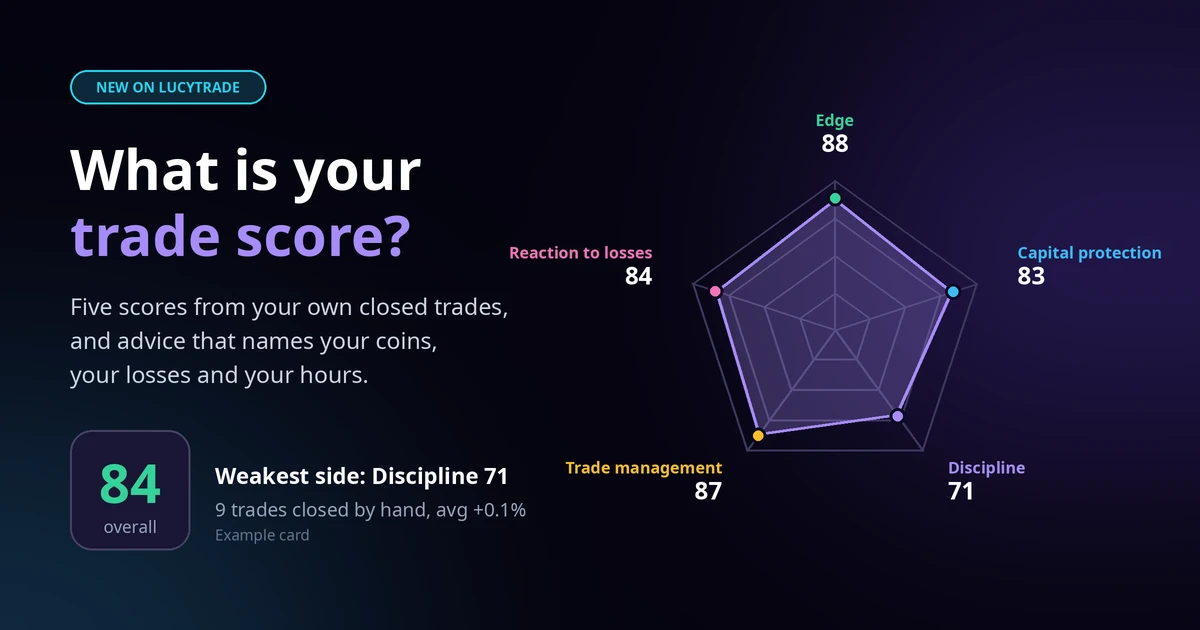
Most traders judge themselves by one number: profit or loss. That number tells you how the month went. It does not tell you why, and it does not tell you what to change.
So we built the Trade Score. It sits at the top of the autopilot trades page and reads every closed trade of your channel. It gives you five scores, one overall score, and advice written from your own trades. It names your coins, your losses and your hours. No two channels get the same text.
The five sides of a trader
A trader can win often and still lose money. Another can lose often and still grow the account. One number hides that, so the Trade Score splits it into five parts.
1. Edge
Do your trades make money on average? Edge looks at your profit factor (total wins divided by total losses) and your average result per trade. A profit factor above 1.5 with a positive average trade is a real edge. It carries the most weight in the overall score, because without it nothing else matters.
2. Capital protection
Did your losses stay inside the risk you planned? Every trade has a stop. This side checks how many losses stayed at or near that stop, and how deep the running total fell at its worst point. A trader who loses small and on plan scores high here, even in a bad week.
3. Discipline
Did your trades close the way the plan said: at the target or at the stop? Trades closed by hand, or cut off by the 24-hour limit, lower this score. Every hand-closed trade is a trade your backtest never saw, so your real results drift away from the tested ones.
4. Trade management
How big are your wins next to your losses, and how many winners reach the target? If your average win is +4% and your average loss is −2%, you can be wrong more often than right and still make money. If it is the other way around, a high win rate will not save you. We explained this in detail in our post on the risk-reward ratio.
5. Reaction to losses
What happens after a loss? This side compares how often the next trade wins after a loss against your normal win rate, and looks at your longest losing run. If trades after a loss do clearly worse, the losses are feeding on each other, and that is something you can stop.
Advice from your own trades, not a fixed list
Under the scores is the part we like most: How to improve each side. It starts with your weakest side and works up. Every line is built from your trades. A few examples of what it can say (the numbers here are only examples):
Most of the loss came from DOGE (−51.8%), while SOL made +12.4%. Take DOGE off the list or give it another strategy, and backtest the change first.
Longs made +38% while shorts made −14%: try letting this strategy take longs only.
3 losses went past their stop; the worst was BNB at −4.5% against a planned −3%. Lower the leverage or use a nearer stop.
10 trades closed at the 24-hour limit, on average +4.7%: they were mostly in profit, so keeping trades open past 24 hours could let them reach their target.
62% of the losses were opened between 00:00 and 04:00 UTC: no-trade hours over that window would have skipped them.
Each piece of advice points to a real setting in LucyTrade: a coin to remove, a side to turn off, a lower leverage, the loss brake filter, no-trade hours, or the option to keep trades open past 24 hours. And when a side is already strong, it says so and tells you to keep it as it is.
How the overall score works
The overall score is a weighted mix of the five sides:
- Edge: 30%
- Capital protection: 20%
- Trade management: 20%
- Discipline: 15%
- Reaction to losses: 15%
70 and above is high, 45 to 69 is medium, below 45 is low. The card also gives a one-line verdict, such as "Strong on every side" or which side is strongest and which is weakest.
The score needs at least 10 closed trades to mean much. With fewer, the card still shows, but it warns you that the sample is small.
How to use it
- Open the autopilot trades page. The card is at the top.
- Read the weakest side first. Its advice tells you what cost you the most.
- Change one thing at a time, and test it on the backtest page before you turn it on. We showed why testing matters when we backtested 13 strategies for a year.
- Come back after another 10 to 20 trades and see if the score moved.